Untitled (from “Still Life”)
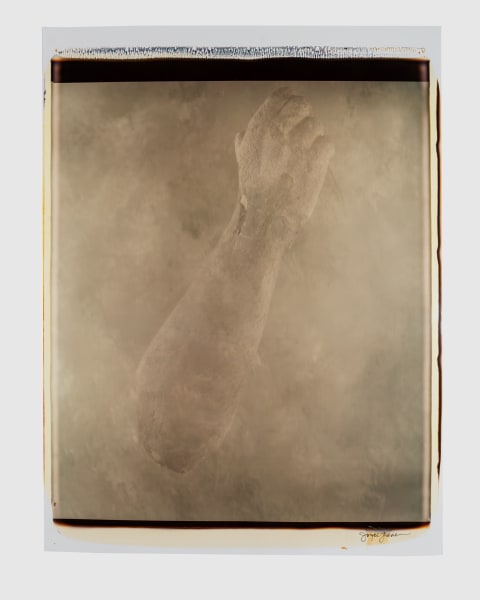
Untitled (from “Still Life”)
Joyce Tenneson
1995-2000 | 20 x 24 inches | Color instant print (Polaroid)
Ruane Center for the Humanities, Lower Level
About the Work
Ancient sculptors used canons—sets of “perfect” mathematical ratios and proportions—to depict the human form. The earliest known canons were developed by the Egyptians, whose grid-based proportions influenced artists from Ancient Greece to Renaissance Europe. These artists across time and space created canons that allowed them to depict their own ideas of the perfect human body—not a body based on a real person, but a body based on a defined harmony among parts. Joyce Tenneson sepia-toned photographs explore the legacy of the idealized body in Still Life, the series of large-format Polaroids on view here. The artworks, which require extensive staging and processing to achieve the symmetrical compositions and atmospheric qualities of each image, serve as a reminder that with idealization comes artifice. In this sense, Tenneson shows us how the body may tell stories that are true for some but not for others.
Collection of Providence College Galleries.