Na(Ni)-M/11
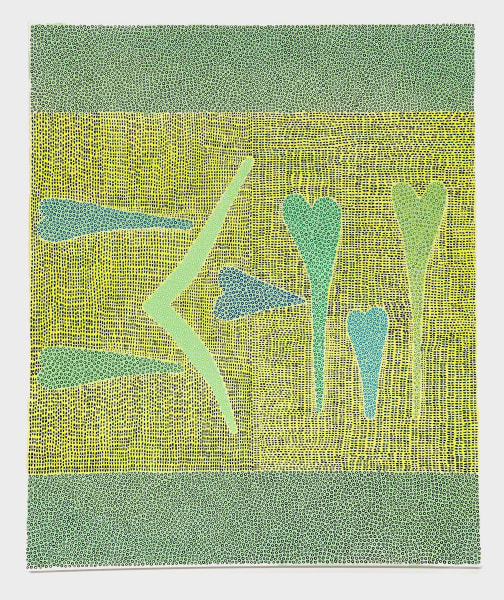
Na(Ni)-M/11
Nadia Haji Omar
2018 | 24 x 20 x 1.5 inches | Acrylic, dye on canvas
Ruane Center for the Humanities, Second Floor
About the Work
Nadia Haji Omar’s two-dimensional works explore the intersection of language and abstraction. Inspired by ongoing research into many kinds of alphabets and scripts, especially Sinhalese, Tamil, Arabic, and French, she strives to discern what makes letterforms and words both visually unique and culturally specific. Her work’s resulting imagery combines linguistic characters with allusions to landscape, mapping, and textile patterning, which in turn often connect to her multicultural background as a person of Syrian, Indian, and Sri Lankan descent living in the West.
The painting Na(Ni)_M/II references the logo-syllabic script Cuneiform. Made up of the wedge-shaped characters used in the ancient writing systems of Mesopotamia, Persia, and Ugarit, Cuneiform was originally developed to write the Sumerian language of southern Mesopotamia (modern Iraq). It is one of the world’s earliest writing systems and its inscriptions survive today mainly though impressions on clay tablets. In her research, the artist found there existed many alternate versions of this script. One that stood out to her was an elongated, heart-shaped interpretation of the individual wedge-shaped characters. She re-presents two consecutive letters from the alphabet—N and M—which translated to Na(Ni) and M in Cuneiform, while the larger, bifurcated sections created by the painted and dyed background form the shape of two Roman numeral I’s.
Collection of Providence College Galleries.