Wearing: Elizabeth Duffy
Wearing: Elizabeth Duffy
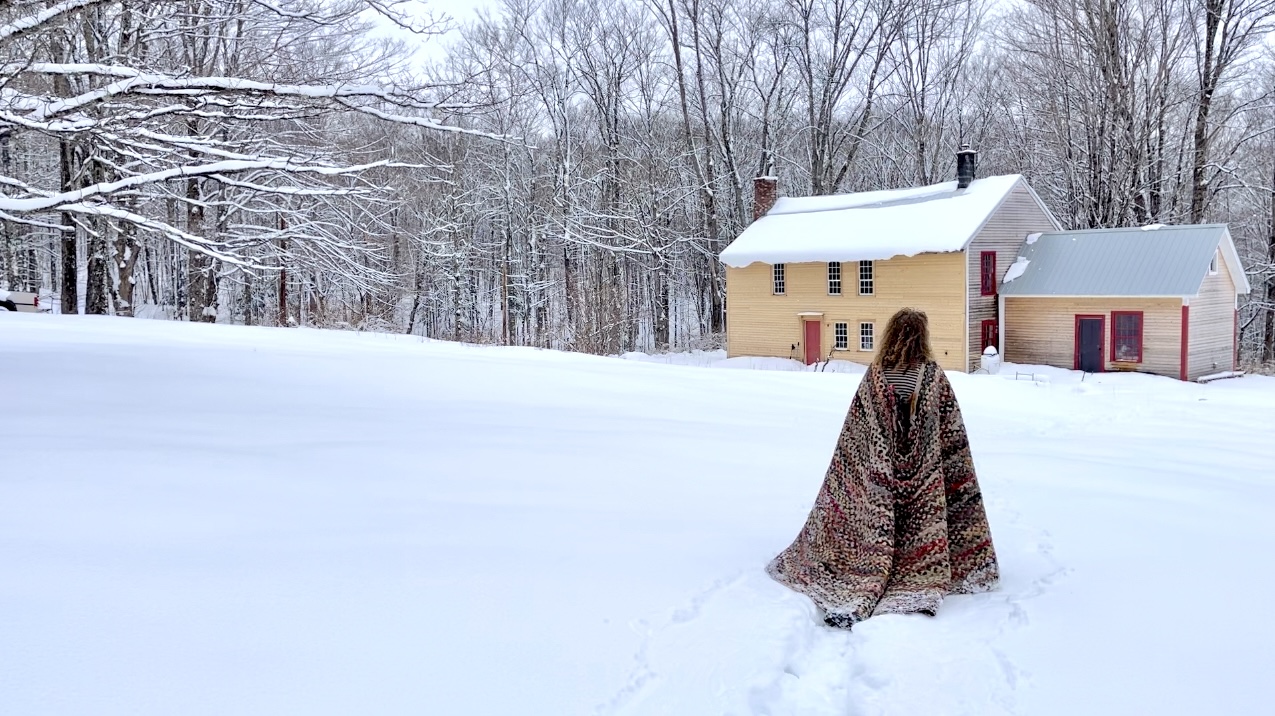
“When will I be recognized for all I have accomplished?!” was my mother’s feverish evening refrain. Every night she asked. Her question pierced through history for me, and in a sense my work is an attempt to respond to her cri de coeur— a refusal to accept the mountain of loss, the destruction and negating of women’s labor and creative output. I am privileged to respond to my mom’s plea by making work that celebrates the creativity of her generation and generations of women before and after her, connecting and listening to their voices— fragile and strong, loud, seething and quiet; no longer invisible.
In Wearing, I disassemble worn braided rugs and transform them into what I imagine they were originally (these rugs were created from cut up leftover, worn clothing & blankets). I chose worn braided rugs because of their role in creating comfort in domestic spaces, the homespun humility of their making, and because I felt ambivalent about them (I grew up in a dairy farming family and they were everywhere in old farmhouses). To young me they were dowdy and fastidious, a gatherer of dust and women’s frustration. Unraveling and reconstructing them is wildly revealing—each anonymous makers’ hand and voice are vividly present in the braiding and stitching, and the radiant patterned fabrics disrupt any notion that the past was a reserved and quaint space. I hunt for well-worn rugs in flea markets and yard sales. Most of the rugs were made by anonymous women homemakers from my mother’s “silent” generation and my Irish immigrant grandmothers’ “lost”—women raised during periods of war and economic depression, for whom self-actualization was a remote possibility given economic insecurity and societal demands placed on them. They cut up their threadbare blankets, coats and clothing to make rugs to embellish the home and keep their floors warm. Their rugs embody resourcefulness, thrift, beauty, humility and care.
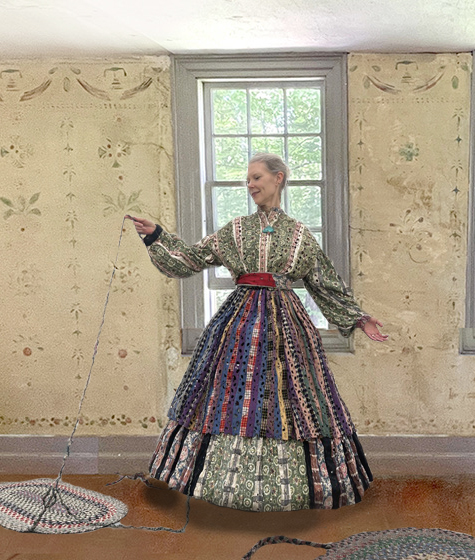
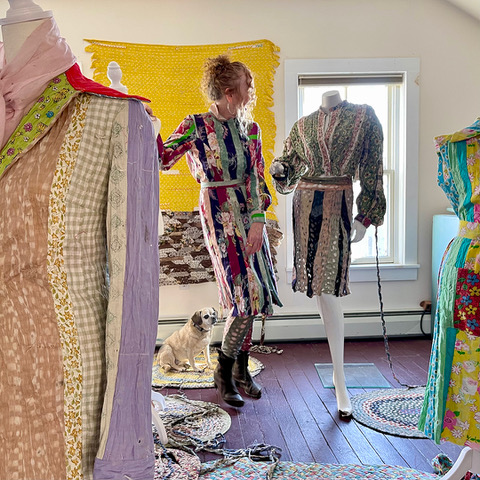
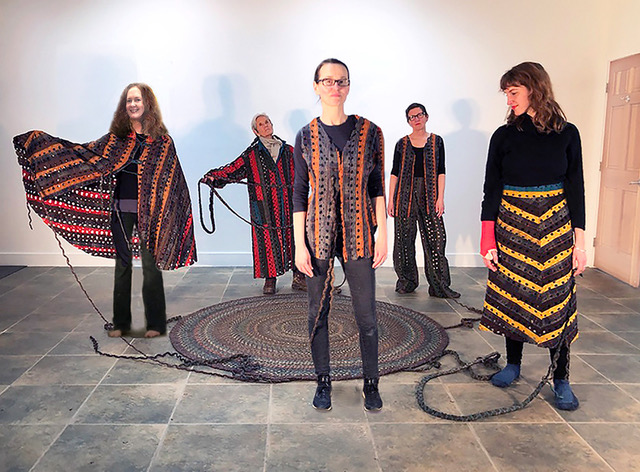
I unbraid each rug, press and sew the narrow strips into cloth, piece them together into fabric and sew them into the garments, blankets and objects they may have been. The unbraiding reveals a myriad hidden patterns and exuberant hues, along with traces of human wear from the tread of feet over time. Lines of dotted holes resembling burn marks indicate years of use from shoes wearing away the surface of the braided rug. Dirt spots like leopard prints trace human movement across time. My process is something like an excavation, uncovering what the rugs hide in between their braids. Sunlight fades and mutes the colors while footsteps imprint and abrade the object, but the folding and braiding keep most of the fabric unexposed, and when unravelled, boisterous patterns and vibrant colors emerge. I keep part of the original rug attached to the objects I create from them, to suggest the cyclical nature of braiding and unbraiding, and as a reminder that all things stay in flux.
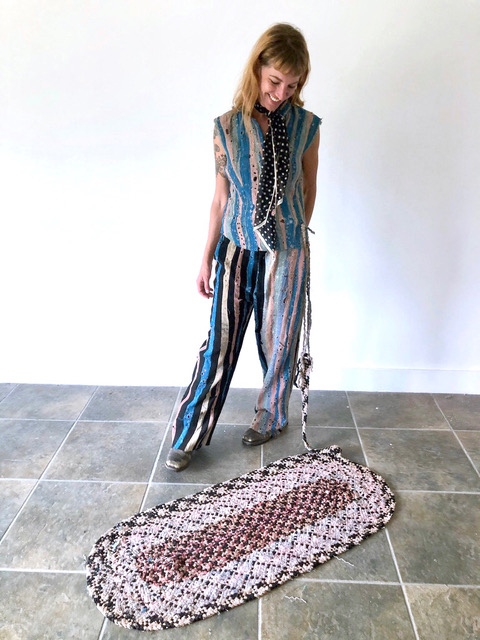
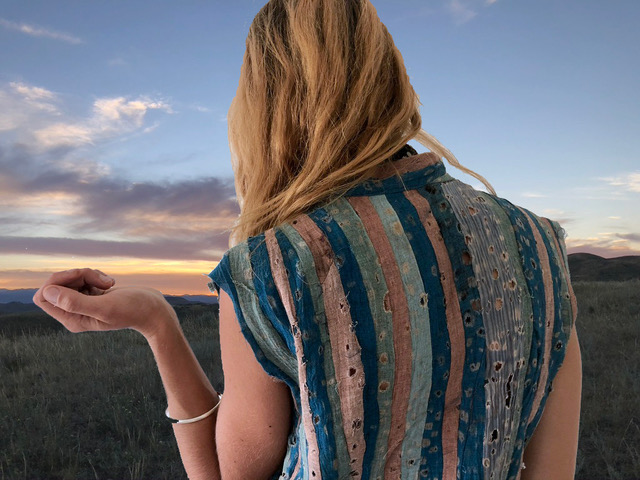
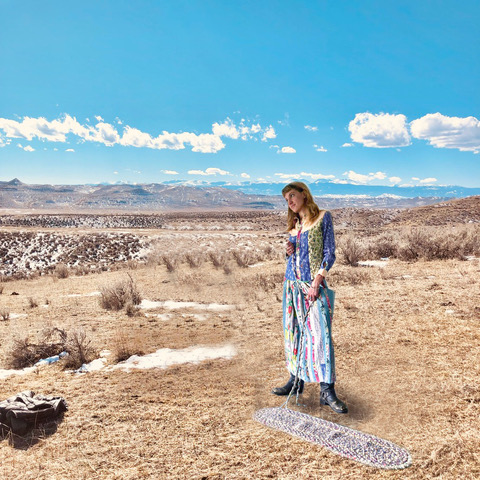
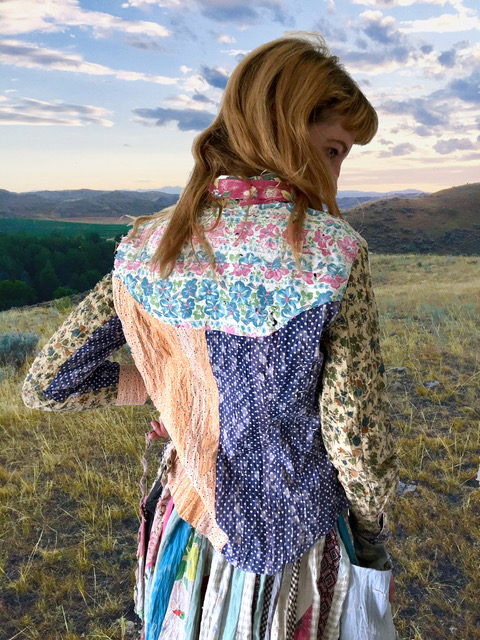
In disassembling the rugs I gather clues about each maker. I wonder who the rugs once belonged to, what the lives of the people who used and made them were like, as they gathered with others and conversed and made work together or in solitude. Their work is an archive of lives lived. I think of these Wearing works as memorial sculptures to these anonymous makers. Each rug is its own complex universe that slowly reveals varieties of personalities, physical attributes and even specific places. Some are made entirely of socks or selvages for example, suggesting employment in or proximity to a textile mill. Sometimes the imprint of the textile mill appears on the fabric; I can google the maker and find out the period and location of the print. I think of my process as a collaboration with each maker and I am consistently fascinated and surprised as our “conversation” unfolds. Often I combine the rugs with furnishings, wallpaper and objects to create immersive tableaux that acknowledge home decoration as an important form of installation art.
Editors note: To read more about Elizabeth Duffy and her work, you can visit her website.
About the Author/s
Elizabeth Duffy has exhibited her work widely including at the Drawing Center, The RISD Museum. the Milwaukee Art Museum, the Aldrich Museum of Contemporary Art, White Columns, Wave Hill, and DM Contemporary. She has held residencies at the Bogliasco Foundation in Italy, the Lower Manhattan Cultural Council, Yaddo, the MacDowell Colony, the Sirius Art Centre in Cobh, Ireland, VCCA, and Ucross. Duffy is the recipient of awards from the New York Foundation for the Arts, the Pollock Krasner Foundation, the National Endowment for the Humanities and the Rhode Island State Council on the Arts, where she was awarded grants in both Sculpture and Craft in 2019. Her work has been written about in the New York Times, Art News, Art on Paper, the Boston Globe, the Village Voice, and many other publications. She has curated exhibitions including Dead Ringer at the Bristol Art Museum and Office Space.
Duffy received her MFA from CUNY/Brooklyn College and her BA at Rutgers College. She studied Textile Conservation at FIT, Jewelry making the School of Visual Arts and painting, drawing, painting and sculpture at the New York Studio School. She lives and works in Providence, RI and teaches in the Art Department at Roger Williams University in Rhode Island and in the Graduate Program at Vermont College of Fine Art.