Nezahualcoyotl: Templo de Santiago ó Quechula
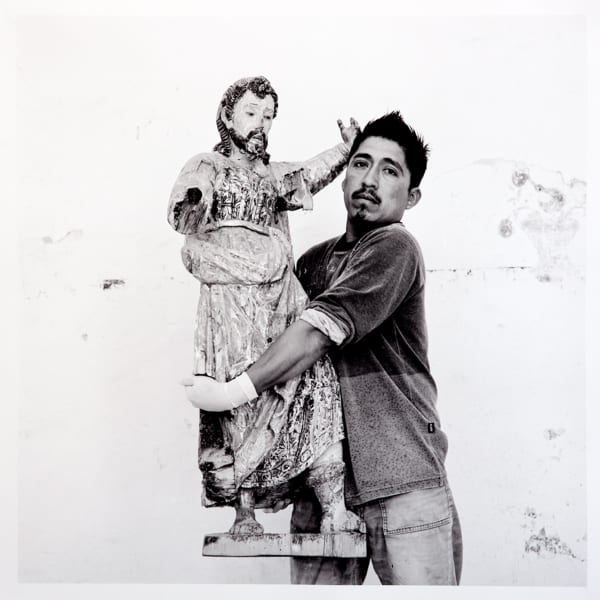
Nezahualcoyotl: Templo de Santiago ó Quechula
Ramiro Chaves
2016-2021 | 16 x 16 inches. | Inkjet print on archival paper
Ruane Center for the Humanities, Ground Floor
About the Work
With support from a network of Dominican friars at Providence College and throughout Mexico, Ramiro Chaves gained access to photograph the sixteenth-century Dominican Temple of Santiago, or the Quechula Templo, in Chiapas. Commissioned under the leadership of Bartolome de las Casas, a Spanish missionary famed for opposing slavery in colonial Mexico, the church’s architecture draws on the diverse architectural traditions favored by the Dominicans—late medieval Mudéjar, Plateresque and Renaissance styles, as well as decorative details indicative of Mayan indigenous cultures. The church was abandoned in the eighteenth century when an outbreak of the plague decimated the area, and in the 1960s, it was submerged under one hundred feet of the Grijalva River to better feed the Nezahualcoyotl reservoir. Due to severe and ongoing drought caused by climate change in the region, the church and its contents have partially emerged several times since 2015.
Both documentary and poetic, Chaves’s black and white photographs of Quechula Temple cast Dominican Catholic history into an imaginative realm, recontextualizing the site’s past with the complex issues of the present day. Wistful portraits of a conservationist, religious artworks, even a dead tree and scrawny horse allude to treasures lost—holy objects sacrificed to modernity, nature ravaged by environmental degradation. Symmetrically composed images show simple yet sturdy architecture, known as the Dominican style, haloed by mountains and mud. The sunbaked adobe brick, like that in the series’ only color photograph, holds up after centuries of harsh sun, decades under water, and dozens of earthquakes. With these photographs, the artist seems to pose the following the questions: How can society preserve cultural heritage, conserve the natural world, and promote progress at the same time?
Collection of Providence College Galleries.